
Tuesday, July 2, 2013
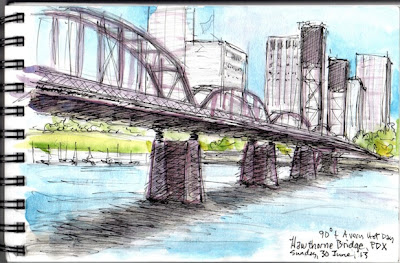
Hawthorne Bridge Sketch, June 30th.
Sunday, the 30th of June ~ Portland, Oregon. I rushed through a sketch of the Hawthorne Bridge. It was ninety plus degrees in the sun... I was melting. This had to be good enough for the moment! Ink and watercolor in my little 5.50" X 8" sketch pad. Cheers from Portland!


Monday, May 27, 2013
At the Lucky Lab
 |
| Hiding out from a rain storm, in Portland, Oregon. The Lucky Labrador Brewery. May 2013. |
Saturday, May 25, 2013

Monday, August 20, 2012
Camp Rainbow Sketching ~ Summer, 2012.

We went camping in the Mt. Hood National Forest this last weekend, and enjoyed the beautiful forest near Ripplebrook Ranger Station. We also had the pleasure of seeing a black bear cub waddling across the road as we explored the back roads nearby. This is a sketch of our campsite that I drew on Friday.
Sunday, July 22, 2012
Drawing from the Masters ~

Every once in a while, I find myself digging into one of my artists anatomy books, and one of my favorites is: "Anatomy Lessons From The Great Masters." Robert Beverly Hale and Terence Coyle put this fine work together in a fine hard cover book, and it reveals the anatomical drawing principles in 100 masterpieces by such greats as Leonardo, Michelangelo, Rubes, Raphael, Durer, Titian, and Rembrandt.
Luca Cambiaso (1527-1585) drew a beautiful pen and wash drawing of CAIN and ABEL, and in a time honored tradition, I've put my hand to work in order to further understand the methods of the Masters. Perhaps it's time to go splash some more ink around....
Saturday, July 21, 2012
In Forest Park

Once again I seek solace
alone in the forest above Portland
reading poems of Li Po and Tu Fu,
halfway between dawn and dusk
beneath falling sprays of amber sun.
Raucous croaks of a crow coughing, twice,
(Wake up! Wake up!)
echo through sentient fir trees
where our dead lay dormant
as vague memories near forgotten
beneath dark, moss draped limbs.
Two golden dragonflies duel overhead -
their immense primaeval shadows fall
upon the grassy meadow below them,
upon the open pages before me.
Portland mumbles in the distance
like the restless drunk does in his sleep
as the blood stained Empire on the Potomac
plots its next war,
and shadows crash to earth.
Sunday, July 1, 2012
Defining My Intentions ~

The Two Corbies, by Arthur Rackham.
As I begin to delve into the world that I am now imagining, some clarification may be useful. And so, I turn to our trusty WIKIPEDIA for the first volley:
Anthropomorphism
From Wikipedia, the free encyclopedia
Anthropomorphism or personification is any attribution of human characteristics (or characteristics assumed to belong only to humans) to other animals, non-living things, phenomena, material states, objects or abstract concepts, such as organizations, governments, spirits or deities. The term was coined in the mid 1700s.[1][2] Examples include animals and plants and forces of nature such as winds, rain or the sun depicted as creatures with human motivations, and/or the abilities to reason and converse. The term derives from the combination of the Greek ἄνθρωπος (ánthrōpos), "human" and μορφή (morphē), "shape" or "form".
As a literary device, anthropomorphism is strongly associated with art and storytelling where it has ancient roots. Most cultures possess a long-standing fable tradition with anthropomorphised animals as characters that can stand as commonly recognised types of human behavior. In contrast to this, conventional Western science, as well as such religious doctrines as the Christian Great Chain of Being propound the opposite, anthropocentric belief that animals, plants and non-living things, unlike humans, lack spiritual and mental attributes, immortal souls, and anything other than relatively limited awareness.
References
http://en.wikipedia.org/wiki/Anthropomorphism
Subscribe to:
Posts (Atom)